
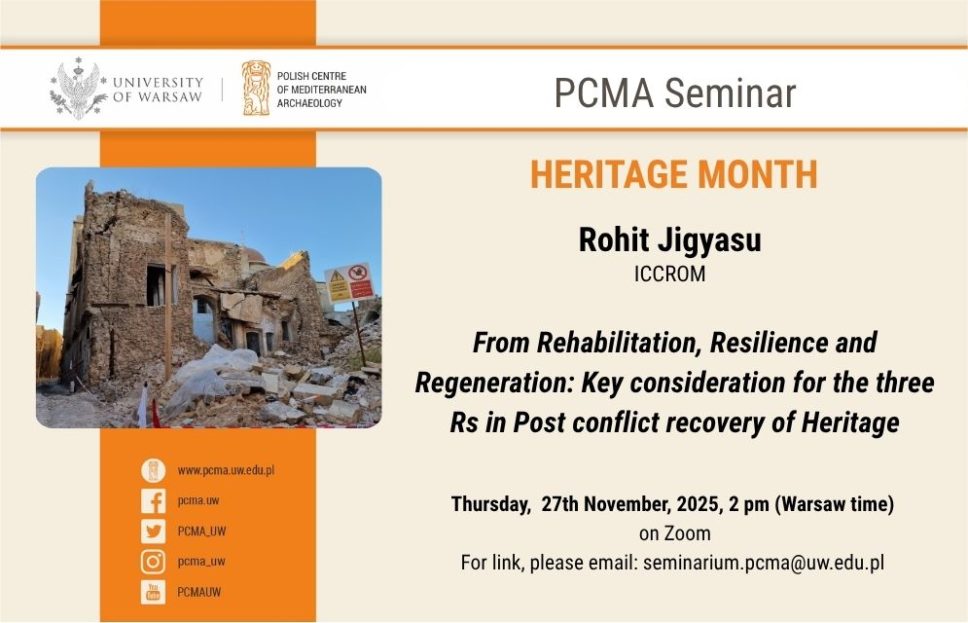
Na najbliższym Seminarium PCMA wystąpi Rohit Jigyasu (ICCROM) z prezentacją: „From Rehabilitation, Resilience and Regeneration: Key consideration for the three Rs in Post conflict recovery of Heritage”.
Abstrakt: Post-conflict recovery of cultural heritage cannot be reduced to the reconstruction of damaged monuments or the replication of historic fabric. Genuine recovery demands a people-centred process that restores the cultural meanings, social functions, and living traditions embedded in heritage places. This lecture explores the “Three Rs” framework: Rehabilitation, Resilience and Regeneration – as an integrated approach to guide recovery efforts in ways that sustain both heritage values and community well-being.
Rehabilitation involves more than repairing physical structures; it strives to reinstate the functions, rituals, and collective practices that give heritage its relevance in daily life. Rehabilitating community life – such as reviving neighbourhood shrines in Bungamati (Nepal) or ensuring continuity of seasonal festivals in post-tsunami Japan – is critical to preserving cultural continuity amid new urban realities.
Resilience focuses on reducing the underlying physical, social, and institutional vulnerabilities that made heritage susceptible to destruction in the first place. Post-conflict rebuilding thus becomes an opportunity to “build back better” – for example, through safer siting, risk-sensitive urban design, and the revival of traditional crafts and knowledge that historically enhanced durability.
Regeneration looks to the future, aligning recovery with new aspirations and inclusive development. Heritage can serve as a driver for peace-building, cultural diversity, livelihood revival, and sustainable urban transformation – as seen in ongoing recovery initiatives in Mosul, L’Aquila, and Stolac.
The lecture argues that the success of post-conflict recovery depends on consensus-building among diverse stakeholders, integration of tangible and intangible heritage, and a territorial approach linking historic cores to wider urban and ecological systems. By embedding the Three Rs into policy and practice, recovery processes can transform crises into opportunities – restoring identity, enhancing disaster and climate resilience, and regenerating heritage as a foundation for a more cohesive and sustainable future.
Seminarium odbędzie się w czwartek 27 listopada o godz. 14.00 na platformie Zoom.
Aby otrzymać link, prosimy pisać na adres: seminarium.pcma@uw.edu.pl
Rohit Jigyasu jest pochodzącym z Indii specjalistą w zakresie ochrony dziedzictwa architektonicznego oraz zarządzania ryzykiem. Obecnie pracuje w ICCROM jako kierownik programu odpowiedzialnego za zrównoważoną ochronę dziedzictwa urbanistycznego i architektonicznego, zarządzanie ryzykiem katastrof i zmian klimatycznych oraz odbudowę po kryzysach.
Rohit pełnił funkcję profesora i kierownika Katedry UNESCO w Institute for Disaster Mitigation of Urban Cultural Heritage na Ritsumeikan University w Kyoto, gdzie odegrał kluczową rolę w opracowaniu i prowadzeniu Międzynarodowego Kursu Szkoleniowego dotyczącego Zarządzania Ryzykiem Katastrof w Dziedzictwie Kulturowym. W latach 2014–2018 był przewodniczącym ICOMOS-India, a w latach 2010–2019 przewodniczącym Międzynarodowego Komitetu Naukowego ICOMOS ds. Przygotowania na Ryzyko (ICORP). Od 2011 roku pełnił funkcję członka Komitetu Wykonawczego ICOMOS, a w latach 2017–2020 jego wiceprezesa.
Przed rozpoczęciem pracy w ICCROM Rohit współpracował z wieloma organizacjami krajowymi i międzynarodowymi, w tym UNESCO, UNDRR, Getty Conservation Institute oraz Bankiem Światowym, w ramach konsultacji, badań i szkoleń dotyczących zarządzania ryzykiem katastrof w dziedzictwie kulturowym. Przeprowadzał również ocenę strat po katastrofach w Indiach, Nepalu, Bhutanie i Japonii.
Przyczynił się do opracowania dokumentu z aktualizacją polityki w zakresie działań klimatycznych dla obiektów światowego dziedzictwa, przyjętego przez Zgromadzenie Ogólne UNESCO w 2023 roku. Jest także głównym autorem Podręcznika UNESCO „Managing Disaster Risks for World Heritage” oraz współredaktorem niedawno opublikowanego „Routledge Handbook on Cultural Heritage and Disaster Risk Management” oraz tomu „Good Practices for Disaster Risk Management of Cultural Heritage”.