
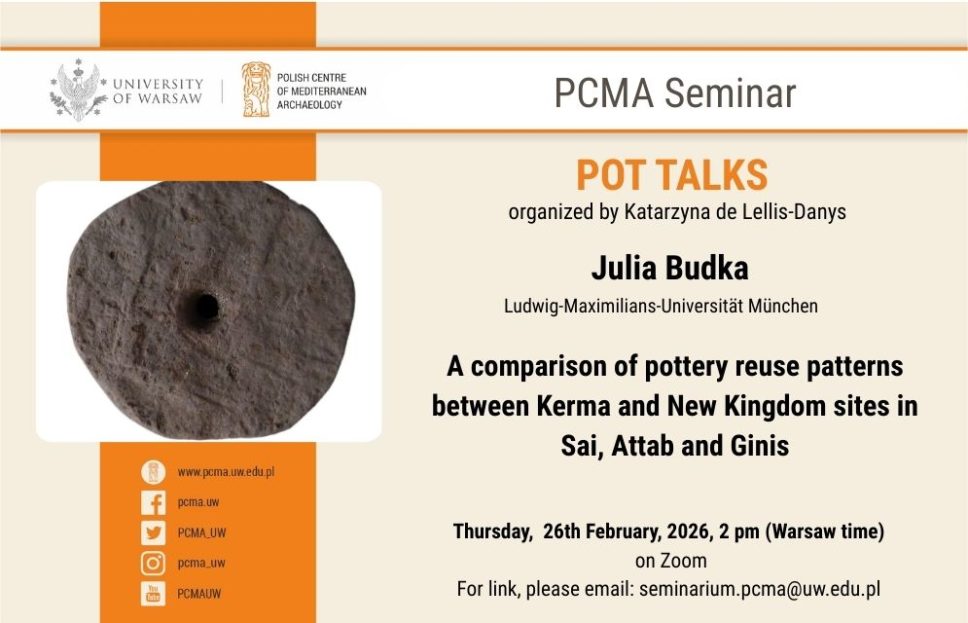
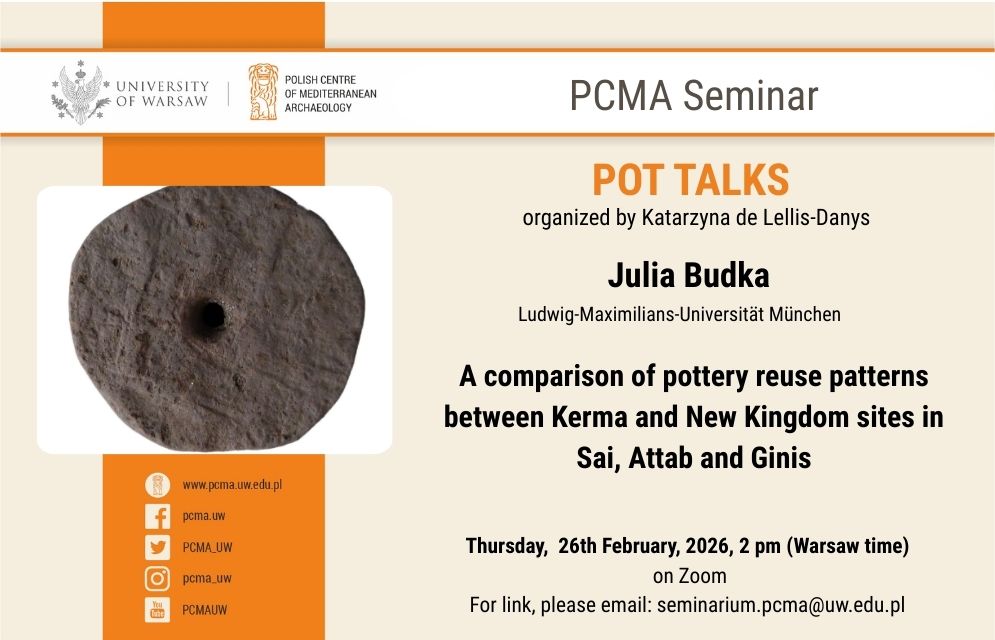
The upcoming PCMA seminar will feature Prof. Julia Budka (Ludwig-Maximilians-Universität München) with a presentation: “A comparison of pottery reuse patterns between Kerma and New Kingdom sites in Sai, Attab and Ginis”.
Abstract: There is substantial evidence for the use of recut pot sherds as tools for different functions at a variety of archaeological sites in the Middle Nile during various periods. The reuse of pottery in Bronze Age Sudan outside of colonial contexts, such as Middle Kingdom fortresses and New Kingdom temple towns, has received only limited research interest.
This lecture presents a series of examples of reused sherds from archaeological sites dating from the Kerma period and the New Kingdom period in the Upper Nubia region around the island of Sai.
The utilisation of reused pottery sherds in archaeological research facilitates the exploration of intriguing lines of enquiry, including the analysis of recycling processes and the investigation of object biographies and use lives. Consequently, the question of whether there are discernible differences between sites associated with the Kerma culture and those of the New Kingdom colonial era arises. It is important to consider the cultural entanglement approach when dealing with the processing of reused pottery sherds in these contexts. This approach gives rise to a number of terminological and methodological issues, which will be discussed in the presentation.
The seminar will be held on Thursday, 26th February at 2 pm (Warsaw time) on the Zoom platform.
To receive the link, please email: seminarium.pcma@uw.edu.pl
The “Pot Talks – A multidisciplinary approach to ceramics from the African area and beyond” is a thematic series within the PCMA Seminar. It is organised by Dr. Katarzyna de Lellis-Danys (PCMA UW and the National Museum in Warsaw). Lectures in this series include topics related to multidisciplinary ceramic research, which will enable participants to exchange experiences with researchers working in different parts of Africa and beyond.