

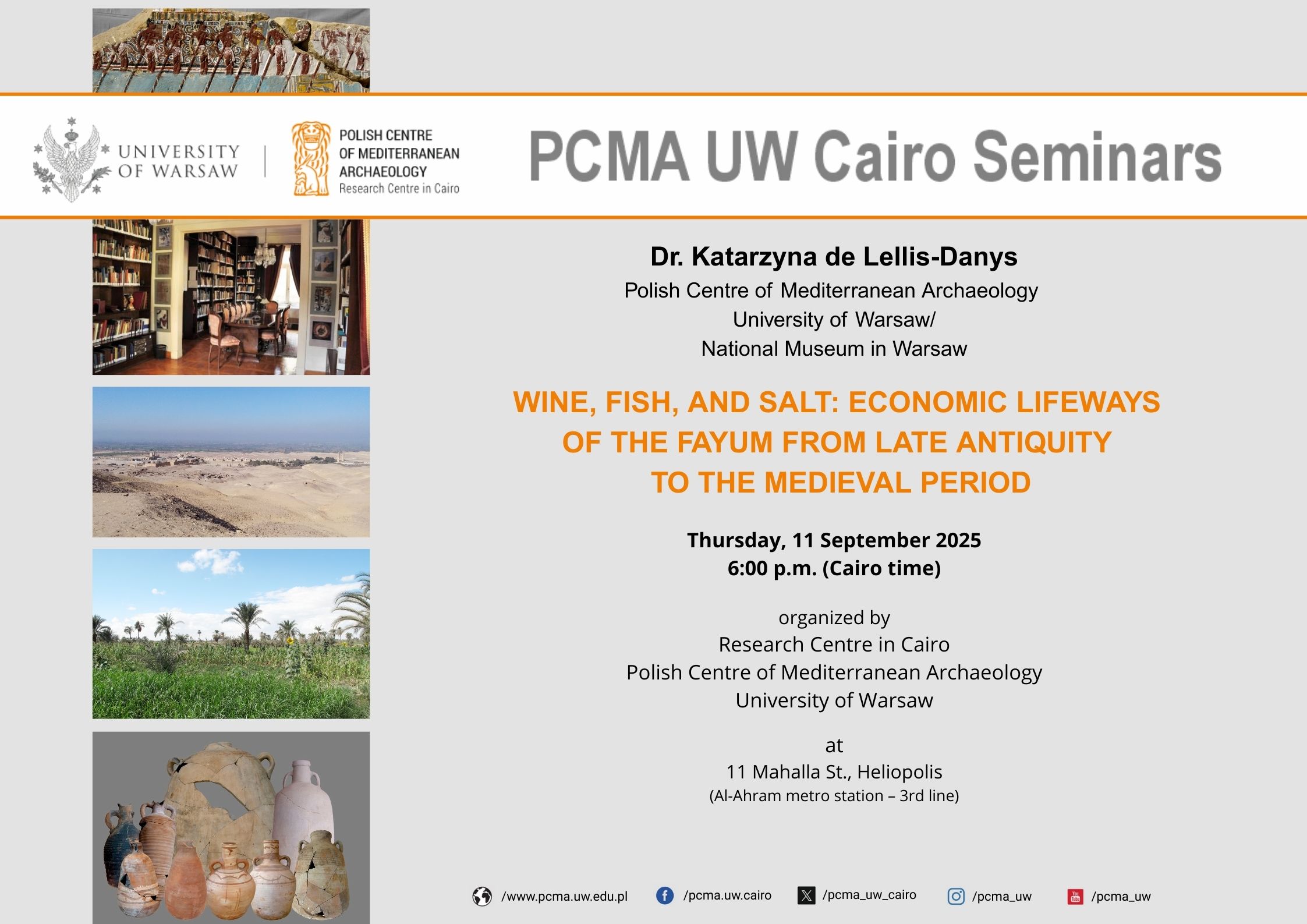
In September, the new PCMA UW Cairo Seminars will begin at the PCMA Research Centre in Cairo, featuring Dr. Katarzyna de Lellis-Danys (PCMA UW, MNW) as the first speaker. She will deliver a presentation: “Wine, Fish, and Salt: Economic Lifeways of the Fayum from Late Antiquity to the Medieval Period”.
This lecture series presents the latest research on Egypt’s heritage — from Antiquity to the modern period — and, in selected cases, on the heritage of neighboring countries. The topics cover the broadest possible spectrum, ranging from archaeological and historical studies to research on material culture, art, religion, and society.
The lectures showcase projects carried out by expeditions of the Polish Centre of Mediterranean Archaeology, University of Warsaw, as well as teams collaborating with the PCMA. The series also features distinguished scholars from other academic institutions whose work significantly contributes to our understanding of Egypt and the region’s past. The series is coordinated by Dr. Anastasiia Stupko-Lubczynska (Head of the Department of Egyptian Archaeology) and Tomasz Kania (Head of PCMA Research Centre in Cairo).
The seminar “Wine, Fish, and Salt: Economic Lifeways of the Fayum from Late Antiquity to the Medieval Period” by Dr. Katarzyna de Lellis-Danys will be held on Thursday, 11 September at 6 pm (Cairo time) at the PCMA UW Research Centre in Cairo, 11 Mahalla St., Heliopolis.
Abstract: The Fayum oasis has long been recognised as one of Egypt’s most fertile and productive regions, thriving especially during the Ptolemaic and Roman eras. Its landscape featured extensive agricultural areas, urban centres, and Coptic monasteries. Rich natural resources connected local producers with other parts of Egypt and the wider Mediterranean. This lecture explores the oasis economy through three key commodities: wine, fish, and salt. Wine from Fayum vineyards was distributed throughout Egypt and beyond; fish from Lake Moeris (Birket Qarun) supported both local consumption and long-distance trade; and salt, extracted from the lake and surrounding deposits, not only preserved food but also linked the oasis to broader economic networks. Using ceramics, archaeological findings, and papyrological sources, the lecture illustrates how the Fayum functioned as a vibrant contact zone where resource demands and trade routes intersected. Ultimately, the case of the Fayum oasis shows how landscapes outside the Nile Valley contributed to both the resilience and evolution of the Egyptian economy during periods of political change.
Dr. Katarzyna de Lellis-Danys is an archaeologist specializing in ceramic studies, affiliated with the Polish Centre of Mediterranean Archaeology, University of Warsaw, and the National Museum in Warsaw. Her research examines the socio-economic and cultural dynamics of Egypt and Sudan from Late Antiquity to the post-medieval period, with particular emphasis on pottery. Her doctoral dissertation focused on the economy of the Fayum Oasis, investigated through the material evidence of the amphorae from Deir el-Naqlun. She has served as pottery team leader in the ERC project UMMA, is head of Greek, Roman, and Byzantine Culture Studies at the PCMA UW, and founded the well-regarded Pot Talks seminar series. Through these roles, she has established herself as a leading voice in the study of Egyptian and Nubian ceramics.
We work on a first-come, first-served basis, as the number of seats is limited. We open our doors at 5:30 and close them at 5:45 or earlier when the lecture room reaches its full capacity. This talk will not be recorded nor livestreamed.