
The results of the second season of Armenian–Polish work in Argishtikhinili, a fortified city of the kingdom of Urartu in Southern Caucasus, have now been announced. Excavation of houses in the residential district and of an urn-field cemetery brought about new information both on the daily and spiritual life of the people inhabiting the site over 2,500 years ago.
The Armenian-Polish Archaeological Expedition led by Dr. Mateusz Iskra of the Polish Centre of Mediterranean Archaeology, University of Warsaw (PCMA UW) and Hasmik Simonyan from the Institute of Archaeology and Ethnography of the National Academy of Sciences of Armenia and the Service for the Protection of Historical Environment and Cultural Museum-Reservations of the Republic of Armenia, work on St. David’s Hill (arm. Surb Davti Blur), one of the two mounds upon which the fortified city is located.
One part of the season’s research focused on large, terraced houses, with ground-floor areas reaching around 400 m², preliminarily dated to the late 7th- 6th century BCE. – “Their state of preservation turned out to be surprisingly good. In many places, floors paved with mud-brick and stone paving have survived intact.” – says Dr. Iskra who is also the head of the Department of Near Eastern Studies at the PCMA UW. Owing to the good state of preservation, archaeologists were able to make several discoveries that shed new light on the daily life of the city’s former inhabitants.
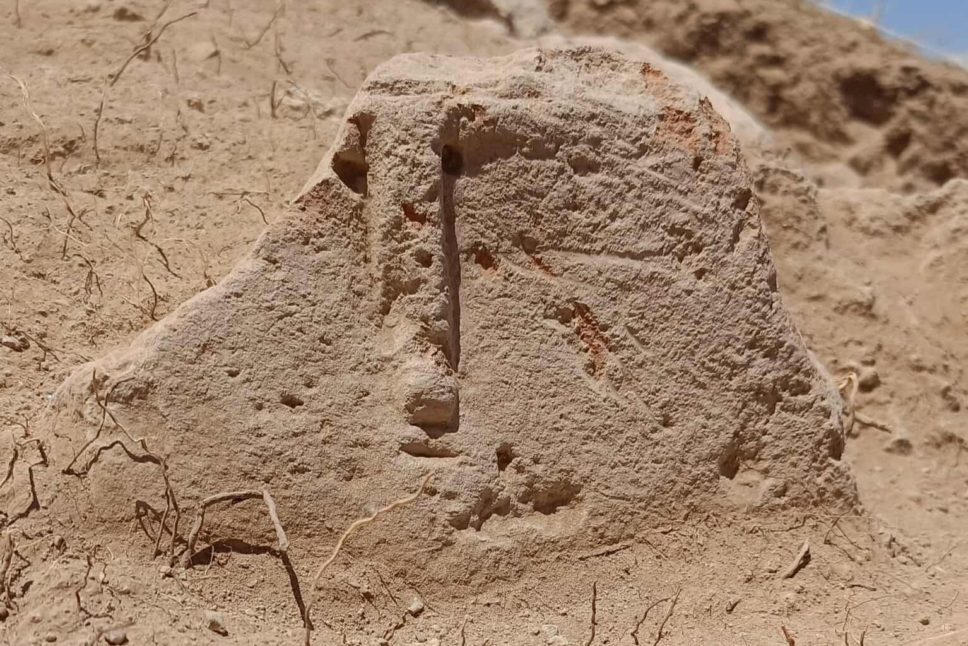
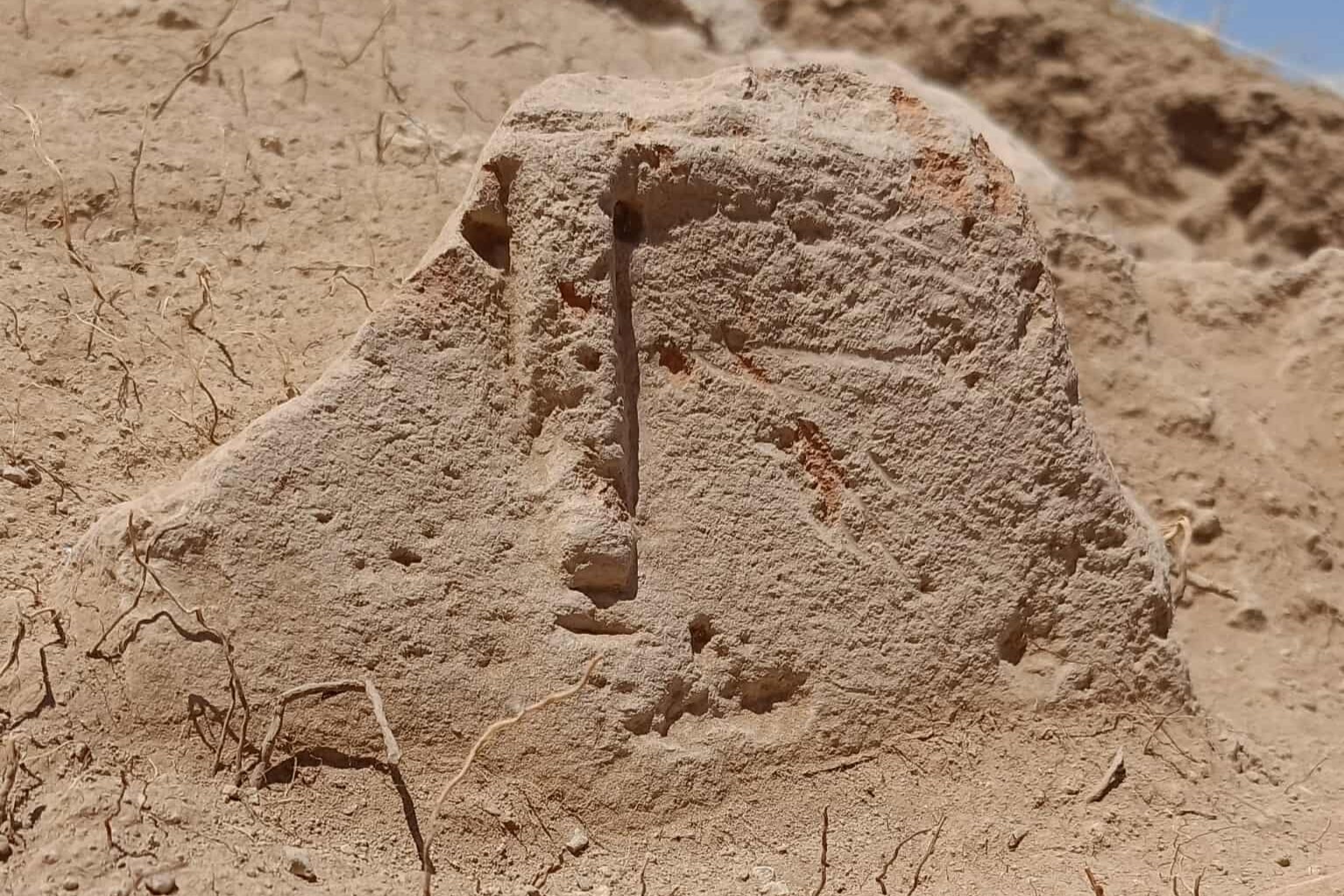
In one of the houses, researchers uncovered the remains of a storeroom, where large storage vessels embedded in the floor were still in place. But the extraordinary find came from an adjacent room. – “Leaning against the side of a stone box, we found – to our surprise – a stone with carved human features. It was a figurine-idol, preserved in its original position” – enthuses Dr. Iskra.
The figure, about half a meter tall, was carved from volcanic tuff. It represents a highly schematic face with clearly defined eyebrows, closely set eyes, a long nose, and narrow lips. According to the archaeologists, such idols are already known from other sites across Armenia and are thought to be linked to a local ancestors’ or fertility cult.
To shed more light on the function of the idol from Argishtikhinili, the researchers plan chemical analyses of the contents of the stone chest, hoping that it may contain some clues for solving this intriguing puzzle.
Another extraordinary discovery of the season was a vast urn field cemetery containing dozens of cremation burials. – “The ashes of the deceased had been carefully placed in ceramic vessels, often accompanied by grave goods,” – explains Hasmik Simonyan, who specializes in bioarchaeology. She adds that this find marks a milestone in Armenian archaeology, both in terms of the burial ground’s scale and the wealth of knowledge it offers, for it is, most likely, the largest and best-preserved urn-field cemetery in Armenia discovered so far.
The remarkable state of preservation of the urns allows researchers to gain deeper insight into the funerary customs and rituals of the communities living here under the strong influence of Urartu. It also opens up new perspectives for studying the social structure, beliefs, and regional interactions of the inhabitants of this area during the first millennium BCE.
The excavations are being carried out jointly by Armenian and Polish archaeologists. This discovery not only strengthens the long-standing academic cooperation between the two countries but also paves the way for further fascinating research into the ancient history of South Caucasus.
Further research at the site is scheduled for spring 2026, marking the first season of a new research project supported by a National Science Centre grant.
Read more about the project: “Household biographies during the decline of state structures. A study of daily life in the houses of the lower city of Argishtihinili during the Late and Post-Urartian periods (7th–6th century BCE)”.
Read more about the site of Argishtikhinili.
Press Release: The idol from Argishtikhinili